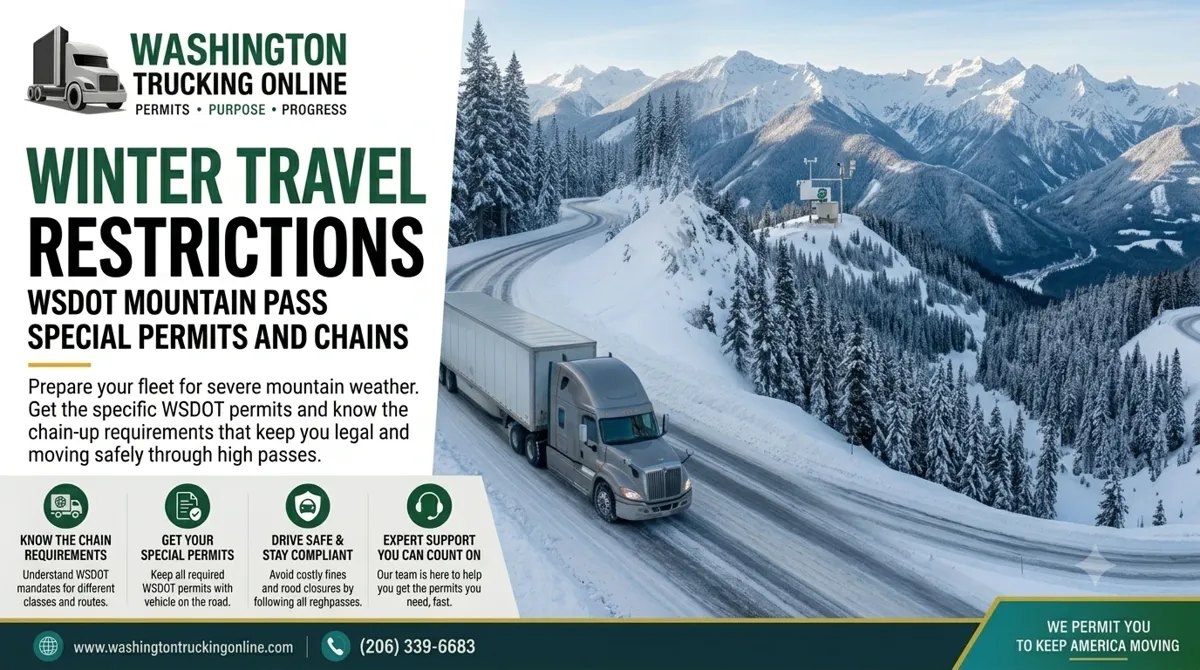
Winter Travel Restrictions: WSDOT Mountain Pass Special Permits and Chains
Table of Contents
-
Introduction
-
Understanding WSDOT Mountain Pass Regulations
-
Mandatory Tire Chain Rules for Heavy Vehicles
-
How Winter Conditions Impact Washington Special Permits
-
Proactive Route Planning Across Mountain Passes
-
Why Choose Washington Trucking Online for Winter Compliance?
-
Frequently Asked Questions (FAQ)
Introduction
Operating commercial motor vehicles through Washington State during the winter months requires precise planning and a clear understanding of mountain geography. The Washington State Department of Transportation (WSDOT) manages some of the most active and weather-sensitive mountain passes in the country, including Snoqualmie Pass (I-90) and Stevens Pass (SR-2). When snow and ice hit these high-elevation corridors, standard operational rules quickly change to protect public safety and keep freight moving.
For interstate carriers and local fleets alike, failing to prepare for Washington winter travel restrictions can result in severe fines, extended roadside delays, or dangerous safety violations at state inspection points. This comprehensive guide breaks down mandatory tire chain requirements, how winter advisories alter the validity of specialized trip permits, and the best practices for keeping your trucks legal all season long.
Understanding WSDOT Mountain Pass Regulations
The cornerstone of Washington’s cold-weather safety protocol is the seasonal requirement to carry winter traction equipment. From November 1 through April 1, all vehicles with a gross vehicle weight rating (GVWR) of more than 10,000 pounds are legally mandated to carry tire chains on major mountain pass routes regardless of current weather conditions or clear road surfaces at the time of transit.
WSDOT enforces these dates strictly because mountain weather is notoriously unpredictable. A corridor that appears completely dry at lower elevations near North Bend can transform into a full blizzard by the time a driver reaches the summit of Snoqualmie Pass. This blanket rule ensures that every heavy commercial vehicle possesses the necessary tools to safely gain traction the moment conditions deteriorate.
Mandatory Tire Chain Rules for Heavy Vehicles
When WSDOT or the Washington State Patrol (WSP) flashes "Chains Required" signs on highway message boards, compliance must be immediate. For commercial trucks, simply throwing a single set of chains over your drive tires is often not enough to fulfill state laws.
Washington administrative code outlines specific placement rules based on your axle configuration:
-
Carry Extra Hardware: All commercial vehicles over 10,000 pounds must carry at least two extra tire chains beyond the minimum configuration required for their specific truck and trailer setup. This provides a critical safety buffer in case a chain snaps or becomes unusable mid-trip.
-
Approved Materials: Chains must feature two-sided construction with hardened metal cross-chains designed to stay in constant contact with the pavement. Plastic traction devices are strictly prohibited by state regulators.
-
Trailer Chaining: For standard five-axle tractor-trailer combinations, the law typically requires chaining all tires on one drive axle, alongside additional chains placed on the outermost tires of the rear trailer axle to prevent dangerous fishtailing.
How Winter Conditions Impact Washington Special Permits
One of the most critical aspects of winter trucking in Washington is how winter weather advisories interact with specialized hauling authorizations. If you are operating under a temporary trip permit, a fuel permit, or an oversize/overweight permit, your paperwork contains specific legal caveats regarding road conditions.
When WSDOT posts a "Traction Advisory / Oversized Vehicles Prohibited" warning on a mountain pass corridor, all movement by oversized loads on that route is instantly banned. Even if you hold a valid single-trip permit or an annual envelope permit, that authorization is temporarily suspended for that highway segment until the advisory is lifted. Attempting to cross a pass with an oversized configuration during an active traction advisory can lead to immediate permit revocation, substantial safety citations, and forced staging at the state line.
Proactive Route Planning Across Mountain Passes
To avoid getting caught in sudden pass closures or facing unexpected enforcement actions, fleet dispatchers and owner-operators must incorporate real-time state alerts into their daily routing routines.
Before sending a driver toward high-elevation segments on I-90, SR-2, or US-97, always verify current chain requirements and restrictions through official WSDOT commercial vehicle portals. Ensuring that your drivers pull into designated, safe chain-up areas early rather than trying to install chains on narrow, snowy highway shoulders keeps your personnel safe and prevents traffic bottlenecks that trigger full pass shutdowns.
Why Choose Washington Trucking Online for Winter Compliance?
Staying on top of seasonal regulations, permit validity windows, and ever-changing state rules can complicate your back-office administrative workflow. At Washington Trucking Online, we remove the logistical stress from state compliance.
Our secure electronic platform allows you to quickly manage temporary trip documentation, track vehicle weight classes, and access your verified credentials instantly from any device. We help you stay organized, informed, and completely prepared for seasonal checks so your fleet remains productive and legal through the toughest winter months.
FAQ
Who needs to carry chains on Washington mountain passes?
All commercial vehicles and combinations with a gross vehicle weight over 10,000 pounds must carry sufficient tire chains from November 1 to April 1 on designated mountain routes, even when skies are completely clear.
Are oversized loads allowed on mountain passes during winter storms?
No. WSDOT strictly prohibits the movement of oversized permit loads on mountain passes whenever a "Traction Advisory" or "Chains Required" notice is active for that specific highway corridor.
What are the penalties for violating Washington tire chain laws?
Drivers who fail to carry or install tire chains when instructed face significant statutory fines from the Washington State Patrol, and their vehicles can be legally barred from entering the mountain pass area until they comply.
Can I use plastic traction devices or cable chains in Washington?
WSDOT rules explicitly ban plastic traction devices for vehicles over 10,000 pounds. However, the Washington State Patrol does allow the use of approved metal cable chains if they deliver equivalent traction performance.
Where can drivers safely install tire chains before a pass?
WSDOT maintains dedicated, signed chain-up and chain-off areas along major interstate approaches, allowing commercial drivers to safely get out of the flow of active traffic to secure their tires.