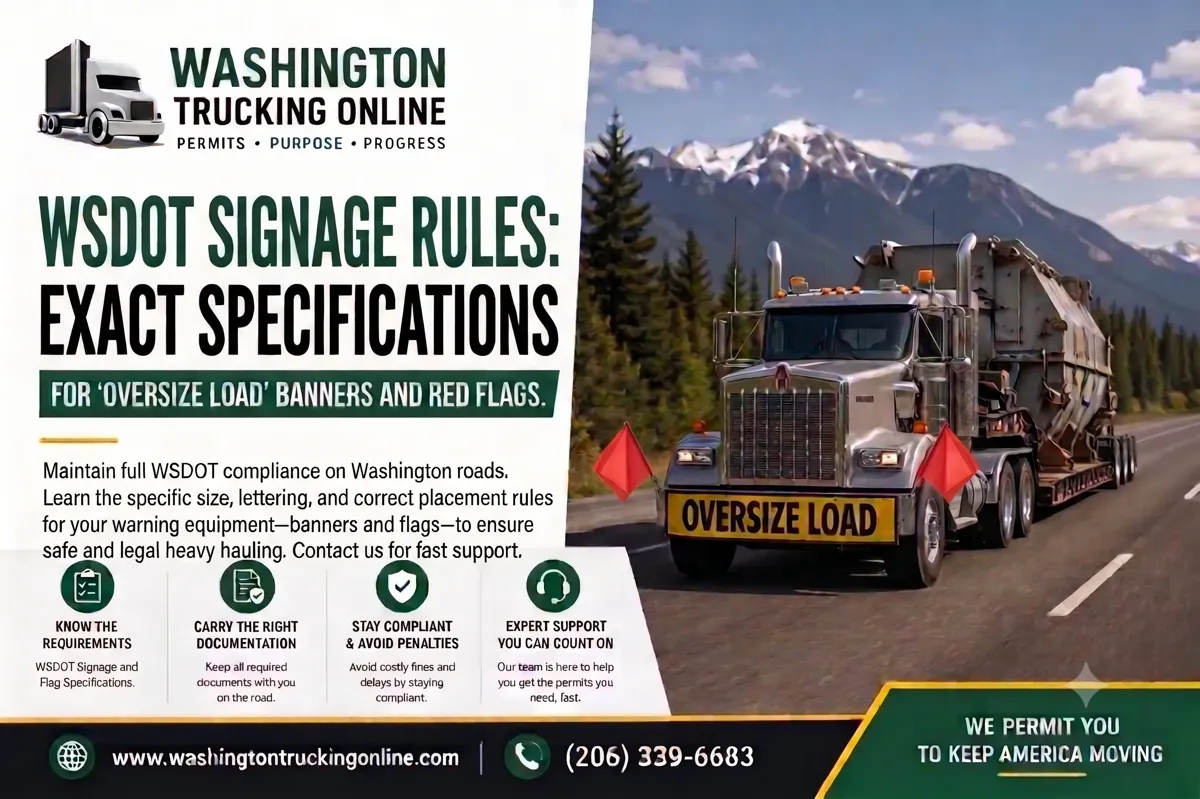
WSDOT Signage Rules: Exact Specifications for 'Oversize Load' Banners and Red Flags
When hauling large freight through Washington State, safety and legal compliance go hand in hand. The Washington State Department of Transportation (WSDOT) establishes strict guidelines to protect truck drivers, passengers, and state infrastructure. If your commercial vehicle exceeds legal dimensions, obtaining the proper temporary permit is only half the battle. You must also display clear visual warnings to inform surrounding traffic of your presence.
Failure to follow the exact dimensions, lettering sizes, and placement requirements for your warning banners and safety flags can result in costly structural delays, steep fines, and unexpected scale stops. This guide clarifies the official WSDOT safety equipment rules in straightforward terms so you can secure your setup and keep your operations moving without interruption.
Table of Contents
-
Introduction to Washington Truck Permits
-
When Do You Need An Oversize Load Permit?
-
WSDOT 'Oversize Load' Banner Specifications
-
WSDOT Red and Orange Safety Flag Requirements
-
Additional Warning Lights and Night Hauling Rules
-
Why Many Trucking Companies Choose Us?
-
Frequently Asked Questions (FAQ)
Introduction to Washington Truck Permits
Before focusing on safety hardware, it is helpful to understand why Washington requires these special configurations. Commercial vehicle rules exist to protect state highways, bridges, and local traffic. When a truck or trailer exceeds standard legal limits, it falls into a specialized category that requires temporary authorization.
The three primary temporary authorizations used by carriers include:
-
Trip Permits: Designed for vehicles that are not permanently registered in Washington State, allowing them to travel legally on state roads for a consecutive three-day window.
-
Fuel Permits: Required for out-of-state trucks not registered under the International Fuel Tax Agreement (IFTA) to cover their fuel tax obligations during short trips across state lines.
-
Oversize/Overweight Permits: Issued for loads that exceed standard legal size or weight limitations, specifying approved routes and mandatory safety markings like banners, flags, and escort cars.
These temporary options ensure that occasional haulers or out-of-state fleets can remain fully legal without completing a lengthy, permanent registration process.
When Do You Need An Oversize Load Permit?
A truck requires a specialized oversize authorization whenever its dimensions exceed the standard legal limits defined by Washington law. In most cases, these standard boundaries are:
-
Width: Any vehicle or load wider than 8 feet, 6 inches.
-
Height: Any vehicle or load taller than 14 feet.
-
Length: Structural limits vary based on the trailer configuration, but a standard semi-trailer cannot exceed 53 feet, and overall combination lengths are tightly regulated.
If your load exceeds any of these standard parameters, you must purchase a single-trip or annual oversize permit. Once that permit is issued, WSDOT regulations state you must display proper safety signage and warning flags to alert the public.
WSDOT 'Oversize Load' Banner Specifications
You cannot simply spray-paint a piece of cardboard and tape it to your bumper. WSDOT enforces precise manufacturing and dimension requirements for "Oversize Load" banners.
To ensure your signage is compliant, it must meet the following metrics:
-
Overall Sign Dimensions: The banner must be exactly 7 feet long and 18 inches high.
-
Text and Lettering: The sign must display the words "OVERSIZE LOAD". The letters must be at least 10 inches tall with a thick, visible brush stroke (at least 1.4 to 1.5 inches wide).
-
Color Combinations: The background must be highway safety yellow, and the lettering must be solid black.
-
Placement on the Vehicle: You must mount one sign to the front bumper of the tractor at a height of 5 feet from the ground (or as close to that height as the vehicle frame permits). A second, identical sign must be securely mounted to the rear face of the trailer or the trailing edge of the load itself.
-
Condition and Use: Banners must be clean, unblocked by license plates or lights, and securely fastened so they do not flap or sag. Crucially, you must remove or cover these signs whenever the truck is traveling empty or carrying a standard, legal load.
WSDOT Red and Orange Safety Flag Requirements
While banners provide clear textual warnings from the front and rear, safety flags outline the widest and longest points of your vehicle for drivers passing on either side. WSDOT rules dictate how and where these flags must be mounted.
-
Size and Material: Safety flags must be square and measure at least 18 inches by 18 inches. They must be solid red or high-visibility fluorescent orange.
-
Placement on Wide Loads: For any load exceeding the standard legal width, you must place flags at all four corners of the widest points of the cargo or trailer frame. If a specific section of the load extends more than 4 inches past the rest of the trailer, an additional flag must mark that specific protrusion.
-
Placement on Long Loads or Overhangs: If your cargo extends past the rear of the trailer, you must place a safety flag at the extreme rear tip of the overhang to prevent rear-end collisions from trailing vehicles.
Additional Warning Lights and Night Hauling Rules
Standard daylight travel hours for oversize loads run from one-half hour before sunrise to one-half hour after sunset. However, certain loads within specific size boundaries are permitted to run at night if they use correct warning light arrays.
When moving an oversize load during evening hours or low-visibility conditions, you must replace or supplement your flags with amber lights visible from the front and sides at the outermost edges. The furthest rearward point of an overlength load must also feature a red warning lamp visible to trailing traffic from at least 500 feet away. Additionally, a flashing or revolving amber strobe light must be mounted to the highest point of the cab or the rear load to offer 360-degree visibility.
Why Many Trucking Companies Choose Us?
Figuring out state routing, calculating axle spacings, and interpreting complex safety equipment codes can slow down your operation. That is why owner-operators and logistics managers rely on Washington Trucking Online to handle their permitting paperwork.
Our service simplifies the entire state procurement system. Instead of navigating confusing government portals or risking a scale violation due to an incorrect form, you can submit your vehicle dimensions to our team. We process your temporary Trip, Fuel, and Oversize permits rapidly, ensuring you receive an accurate document with your exact route restrictions explicitly laid out. By leaving the paperwork to Washington Trucking Online, your drivers can focus entirely on securing their banners, fastening their safety flags, and completing their runs safely.
Frequently Asked Questions (FAQ)
Can I use a "Wide Load" sign instead of "Oversize Load" in Washington? WSDOT rules specifically require the phrase "OVERSIZE LOAD" on standard temporary permits for loads exceeding width, height, or length limits. It is best to stick to the standard wording to avoid issues at state-scale houses.
Are mesh banners legal to use in Washington State? Yes, mesh and vinyl banners are legal as long as they meet the exact 7' x 18" size requirements, feature 10-inch black lettering, and remain fully legible without twisting or tearing while traveling at highway speeds.
What happens if I forget to remove my oversize signs when empty? Displaying an "Oversize Load" sign when your truck is operating at standard, legal dimensions is a compliance violation. You must remove, fold up, or cover the banners when you are not actively hauling permitted freight.
Do I need flags if my load is tall but not wide? Flags are primarily utilized to mark structural width boundaries and rear overhangs. However, your permit paperwork will outline the exact equipment configuration required for your specific cargo dimensions.