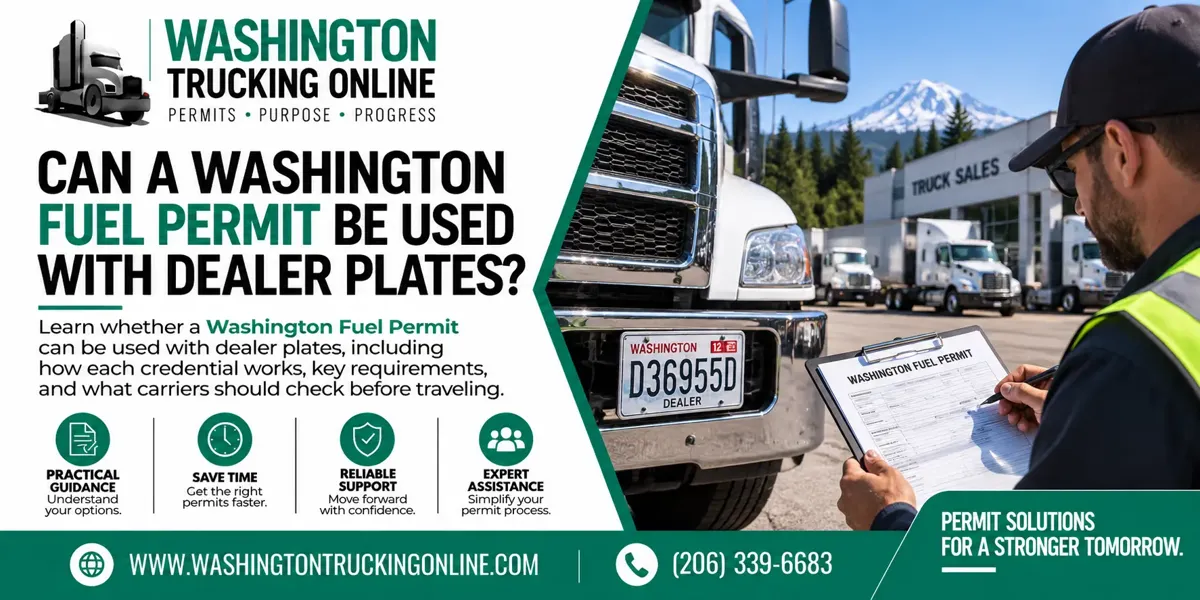
Can A Washington Fuel Permit Be Used With Dealer Plates?
Table Of Contents
-
Introduction
-
How A Washington Fuel Permit Works
-
What Dealer Plates Are Designed For
-
Can A Washington Fuel Permit Be Used With Dealer Plates?
-
When The Combination Can Create A Problem
-
What Carriers Should Check Before Traveling
-
How To Avoid Permit Problems
-
Why Many Trucking Companies Choose Our Service
-
FAQ
Introduction
Dealer plates can create questions when a commercial truck needs temporary fuel authorization for travel in Washington. A carrier may assume that a dealer plate provides the same authority as regular commercial registration.
That can be a mistake. A Washington Fuel Permit and a dealer plate serve different purposes. The fuel permit addresses fuel-tax requirements for qualifying commercial vehicles, while dealer plates are subject to specific rules governing how dealer vehicles may be operated.
How A Washington Fuel Permit Works
A Washington Fuel Permit is required for certain diesel- or propane-powered commercial vehicles entering Washington when they do not pay fuel tax under IFTA. Qualifying vehicles can include certain commercial vehicles based on factors such as axle count and gross vehicle weight.
The permit is temporary and valid for three consecutive days. It applies to the vehicle for which it was purchased, so carriers should verify the vehicle information before travel.
A fuel permit does not replace every registration or licensing requirement. The vehicle must still have lawful credentials for the specific operation being performed.
What Dealer Plates Are Designed For
Washington dealer plates are not general-purpose commercial plates. They are intended for specific dealer-related activities, including demonstrating vehicles held for sale or lease, moving vehicles to or from a dealer, and certain movements involving service or repair before a vehicle is sold or leased.
Dealer plates therefore have specific restrictions on who may use them and how the vehicle may be operated. They should not automatically be treated as ordinary commercial registration simply because they are attached to a truck.
For trucking companies, this distinction is especially important when a vehicle moves from dealership activity into regular transportation service.
Can A Washington Fuel Permit Be Used With Dealer Plates?
A Washington Fuel Permit does not expand the lawful purposes for which a dealer plate may be used.
If a vehicle is being operated for an authorized dealer purpose and separately qualifies for a Washington Fuel Permit, the carrier should review both credentials together. The fuel permit addresses the fuel-tax requirement, while the dealer plate remains subject to its own usage restrictions.
For example, a dealer may need to move a vehicle from a dealership to another location as part of a permitted dealer activity. If the vehicle also meets the requirements for a temporary fuel permit, that permit can address the fuel-tax side of the trip.
A different situation exists when a trucking company wants to use a dealer-plated truck for regular customer freight. The carrier should not assume that obtaining a Washington Fuel Permit makes that operation acceptable. The underlying plate and registration authority must also support the actual use of the vehicle.
When The Combination Can Create A Problem
The main risk is treating the fuel permit as permission to use dealer plates for any commercial purpose.
A carrier can have a valid Washington Fuel Permit and still have a problem if the dealer plate is being used for an unauthorized purpose. The opposite can also occur: the dealer plate may be properly used while the vehicle still needs a fuel permit.
Dispatch should therefore review these two issues separately. First confirm that the dealer plate is lawful for the planned activity. Then determine whether Washington fuel-tax requirements require a temporary fuel permit.
What Carriers Should Check Before Traveling
Before sending a dealer-plated vehicle into Washington, review the complete credential package.
Check the following:
-
Confirm the dealer plate belongs to the vehicle.
-
Confirm the planned use is authorized for the dealer plate.
-
Check whether any required dealer documentation applies.
-
Determine whether the vehicle qualifies for a Washington Fuel Permit.
-
Check the vehicle's axle count and gross vehicle weight.
-
Verify whether the vehicle is covered by IFTA.
-
Confirm the fuel permit is valid for the travel dates.
-
Make sure the permit information matches the truck.
-
Keep the applicable documents available during the trip.
The fuel-permit rules and dealer-plate rules address different requirements, so both should be reviewed before the vehicle travels.
If the truck is moving from dealer use into regular carrier service, review the registration and plate arrangement before dispatch. A change in use can change which credentials are appropriate.
How To Avoid Permit Problems
The easiest way to prevent problems is to separate plate authorization from fuel-tax compliance.
Do not ask only whether the truck has a plate. Confirm what type of plate it is, who is operating the vehicle, what the truck is being used for, and whether the applicable fuel-tax requirements are satisfied.
Keep dealer documentation and Washington Fuel Permit records together when both apply. If the vehicle is sold, transferred, or placed into regular carrier service, review its credentials again before the next trip.
A short pre-trip review can prevent a carrier from relying on a valid fuel permit while overlooking restrictions connected to the dealer plate.
Why Many Trucking Companies Choose Our Service
Washington Trucking Online gives trucking companies a straightforward way to manage permit applications without handling every administrative step on their own. Our service helps carriers save time, simplify permit processing, reduce paperwork, and avoid unnecessary delays when determining the appropriate Washington credentials for a planned trip.
With fast processing, accurate permit assistance, and dedicated customer support, Washington Trucking Online makes the permit process more convenient. Carriers can spend less time on administrative details and more time focusing on drivers, vehicles, and scheduled transportation operations.
FAQ
Can a dealer-plated truck have a Washington Fuel Permit?
Yes, the two credentials address different issues. The vehicle must still be used in a manner authorized for the dealer plate and must meet the applicable fuel-permit requirements.
Does a Washington Fuel Permit replace a dealer plate?
No. A fuel permit addresses temporary fuel-tax requirements. It does not replace the plate or expand the authorized use of a dealer-plated vehicle.
Can a carrier use dealer plates for regular customer freight?
Do not assume so. Dealer plates have specific use restrictions, and regular customer freight may require different registration and carrier credentials.
What should a carrier check before entering Washington?
Review the dealer-plate authorization, vehicle information, IFTA status, weight and axle information, fuel permit validity, and supporting documents.
What if the vehicle changes from dealer use to carrier use?
Review the registration and plate status before dispatch. A change in use may require different credentials for regular commercial operations.
For more information, visit the Washington State Department of Licensing.