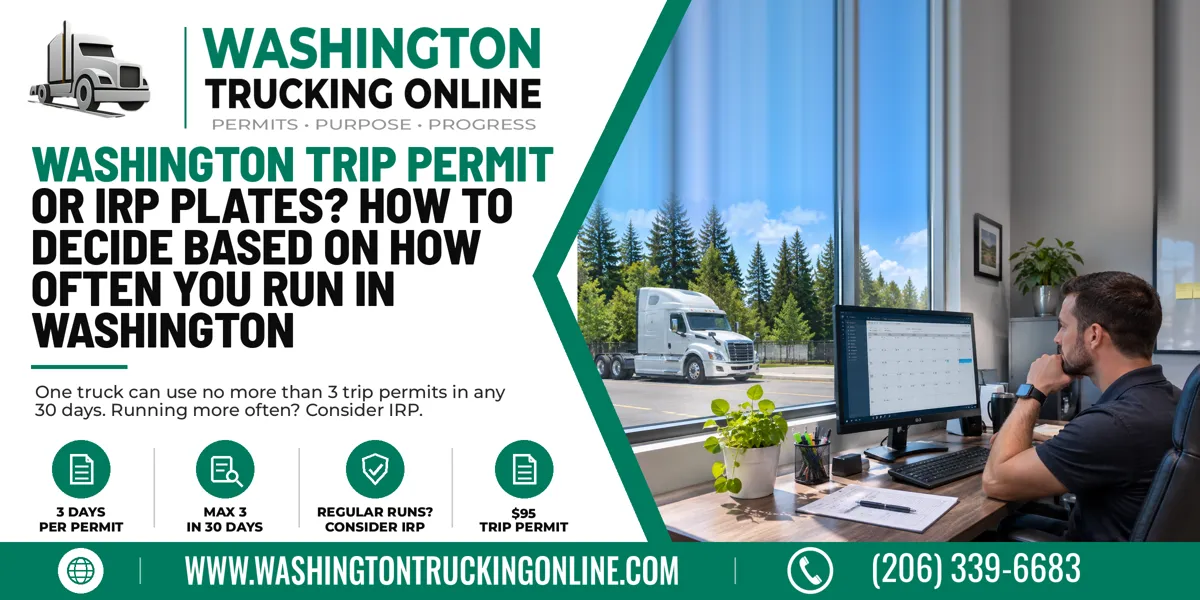
Washington Trip Permit or IRP Plates? How to Decide Based on How Often You Run in Washington
Table Of Contents
-
Introduction
-
The Short Answer
-
What a Washington Trip Permit Covers
-
The 3-in-30 Limit That Decides for Many Carriers
-
What IRP Plates Give You
-
How Often Do You Run in Washington?
-
Quick Decision Guide
-
Three Real-World Examples
-
Mistakes That Push Carriers Into Trouble
-
Why Many Trucking Companies Choose Our Service
-
FAQ
Introduction
Every carrier that sends a truck into Washington faces the same question sooner or later: should you buy a Washington Trip Permit each time, or add Washington to your apportioned IRP registration and stop worrying about it?
The right answer depends mostly on one thing: how often your truck actually runs in the state. This guide explains what a trip permit covers, the limit that stops carriers from relying on trip permits forever, and how to choose the option that fits your operation.
The Short Answer
If your truck runs in Washington only now and then, a Washington Trip Permit is usually the simpler choice. If it runs in Washington regularly, IRP plates that include Washington are usually the better fit.
Washington law sets a hard limit. Under RCW 46.16A.320(3)(a), no more than three trip permits may be used for any one vehicle in any thirty consecutive day period. If your schedule needs more than that, trip permits can't legally cover it.
What a Washington Trip Permit Covers
A Washington Trip Permit lets a vehicle owner operate an unregistered vehicle on Washington public highways. Under RCW 46.16A.320, each permit:
-
Covers a single vehicle, the one identified on the permit,
-
Lasts three consecutive days, beginning with the day of first use,
-
Authorizes operation at the maximum legal weight limit for that vehicle,
-
Must be completed in full and signed by the operator before driving,
-
Must be displayed on the vehicle as the department requires.
A truck is treated as unregistered for this purpose if, for example, it would be required to register in Washington under reciprocal agreements, its tabs have expired, or its gross weight license is too low for the load.
The 3-in-30 Limit That Decides for Many Carriers
This rule is the key to the whole decision. One truck may use no more than three trip permits in any 30 consecutive days.
Since each permit covers three days, that's a maximum of about nine days of trip permit coverage in any rolling 30-day window. The window is rolling, not monthly, so you can't use three permits at the end of one month and three more at the start of the next.
Once a truck needs to be in Washington more than that, trip permits stop being an option, and IRP registration for Washington becomes the practical path.
What IRP Plates Give You
The International Registration Plan (IRP) lets a carrier register a truck once in its base jurisdiction and add the other states and provinces where it travels. Registration fees are shared among those jurisdictions.
With Washington on your IRP cab card:
-
No permit per trip. The truck can enter Washington whenever the load calls for it.
-
No 3-in-30 limit. The trip permit cap doesn't apply.
-
Less paperwork at the last minute. There's no permit to buy, sign, and display before each run.
The trade-off is planning. IRP registration is a yearly commitment, so it pays off when Washington is part of your regular routes.
How Often Do You Run in Washington?
Before you decide, look honestly at your schedule:
-
Count Your Washington Trips. Check the last few months of loads and note how many entered Washington.
-
Count the Days. A trip that lasts more than three days may need more than one permit.
-
Look at the Next Season. Are new customers or lanes in Washington coming up?
-
Check the 30-Day Window. If any 30-day stretch needs more than three permits, trip permits won't work.
Quick Decision Guide
| Your Washington Schedule | Better Fit |
|---|---|
| A few trips a year | Washington Trip Permit |
| Seasonal runs, under 3 permits per 30 days | Washington Trip Permit |
| More than 3 permits needed in 30 days | IRP plates with Washington |
| Weekly or regular Washington lanes | IRP plates with Washington |
Three Real-World Examples
-
The occasional load. An Idaho carrier takes one load into Spokane every couple of months. One Washington Trip Permit per trip is simple and well within the limit.
-
The harvest season. A carrier hauls into Washington for six weeks every fall, about once a week. That would need more than three permits in some 30-day periods, so trip permits alone won't cover it.
-
The regular lane. An Oregon fleet runs to the Seattle area every week. IRP plates with Washington save time and keep the trucks legal without a permit every trip.
Mistakes That Push Carriers Into Trouble
-
Ignoring the 30-day count. A fourth permit within 30 days isn't allowed.
-
Assuming a permit lasts a full week. Each permit covers three consecutive days.
-
Using one permit for two trucks. Each permit covers a single vehicle.
-
Driving before signing. The operator must sign the permit first.
-
Forgetting the penalty. Under RCW 46.16A.320(6), a violation of the trip permit law is a gross misdemeanor.
Why Many Trucking Companies Choose Our Service
Washington Trucking Online helps carriers that run into Washington only now and then get the right Washington Trip Permit quickly, and we help you keep track of the 3-in-30 limit so every trip stays legal.
-
Trip permit: $95
-
Fuel permit: $95
-
Oversize permit: $98
We provide support 24/7 and also work weekends and holidays.
or
FAQ
How long is a Washington Trip Permit valid?
Three consecutive days, beginning with the day of first use.
How many Washington Trip Permits can one truck use?
No more than three for any one vehicle in any 30 consecutive days.
When should I switch to IRP plates?
When your truck runs in Washington often enough to need more than three permits in 30 days, or on a regular weekly schedule.
Can one trip permit cover two trucks?
No. Each permit covers a single vehicle identified on the permit.
How much does your Washington Trip Permit service cost?
Our Washington Trip Permit service is $95.
For more information, visit the Washington State Department of Licensing.